

Goodbye January. Hello February.
So I imagine you, too, are now rolling out changes, launching projects, streamlining processes, optimizing workflows, fine-tuning operations, and scaling up initiatives ... doesn't the language we use to talk about work can make it feel like we're cogs in a machine?
Yes. And there's a reason for this—the metaphors we work by come from the same source of our organizing system: the industrial era.
It's a fact we no longer live in the industrial era, but for a number of reasons, the organizations we work for still operate as they do.
That straightforward truth explains just about all frustration with modern work—as our industrial-era management approaches collide with post-industrial realities, the result is everything from small daily frictions to deep systemic dysfunction—whether it's
- the nurse's frustration with being understaffed
- or the middle manager's frustration with being squeezed between strategic directives and operational realities,
- or the primary care physician's frustration with waiting for the next capital budget cycle to replace failed equipment,
- or the CEO's frustration with change happening at a much-too-slow pace,
- or the board of directors' frustration with quarterly targets that keep getting missed ...
So what's going on? Why, especially after years and years and years of the same frustrations is everyone ... still feeling frustrated?
As simply as it can be stated: the success of industrial management haunts us. Our organizations can't let go of what worked so well for so long. And we can use what Niels Pflaeging calls the "Taylor Bathtub" to understand why.
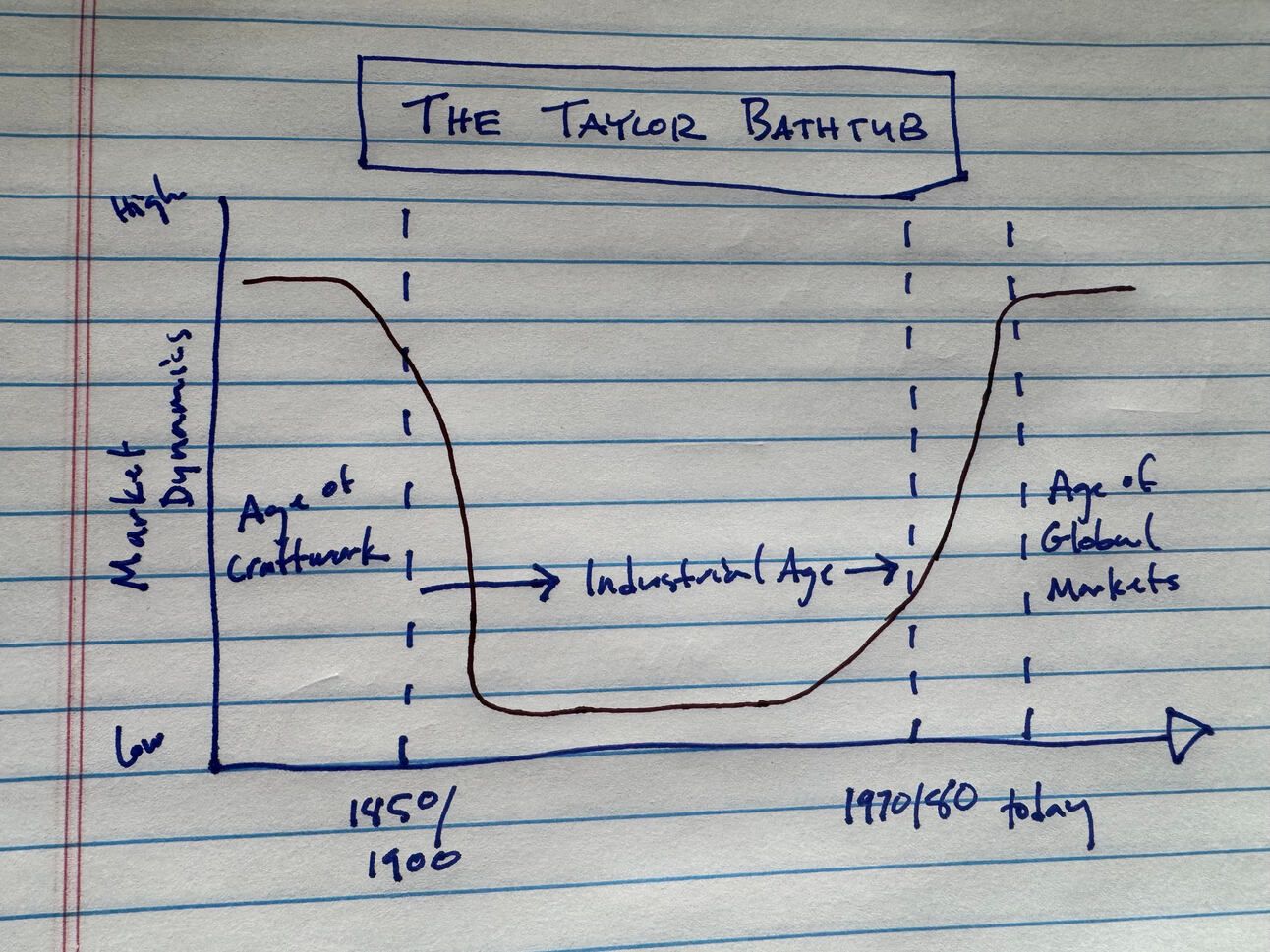
The “Taylor Bathtub” from Niels Pflaeging’s book “Organize for Complexity”
The Taylor Bathtub traces how organizations have approached creating value for customers over time—from the age of craftwork through today.
Before 1900, creating value meant a craftsperson adapted to each customer's individual needs. Then the industrial age brought something revolutionary: the ability to standardize and scale (the same Model T for everyone). This wasn't good or bad—but it transformed how work could be organized. And it worked amazingly well, allowing organizations to grow larger and more efficient than ever before.
But what the Taylor Bathtub reveals is that this mass-standardization approach was temporary. Starting in the 1970s, the need to adapt to customer needs returned—and now at global scale, with more complexity than ever before.
The irony is rich: the very tools of industrialization (mass production, global supply chains, standardization, ...) created the foundation for today's complex, interconnected world. The success of industrial approaches made it possible to build the huge, modern organizations we work for.
The Taylor Bathtub helps explain a crucial tension: While healthcare's operating environment has evolved to create value within this complexity, our organizations' management approaches largely haven't.
Industrial-era management succeeded so well that it has become seen as the only way to operate an organization. This approach created unprecedented success—so who could blame anyone for sticking with what works?
But as the Taylor Bathtub helps us see, this success came from a specific historical period when standardization was both a) possible and b) desirable—and not because it's the only approach available.
Here's the challenge: Industrial thinking is so deeply embedded in how we see organizations that we often don't recognize it as a choice for how to organize work.
So when organizations face new challenges, sometimes even existential ones, the instinct is still to:
- Add more standardization (like creating a process for every situation)
- Increase control (more oversight, more metrics)
- Create more detailed procedures (approval processes so time consuming that the problem changes by the time the work starts)
- Separate thinking from doing (executives plan while frontline staff execute)
- Reduce all variation (like standardizing visit times despite different patient complexities)
The result? Everyone's frustrated. And as the Taylor Bathtub shows us, it's the predictable result of using an industrial-era approach in the attempt to create value for customers in a post-industrial world.
We (often it's "we" the royal we, and sometimes it's just we the individual we) reach for these industrial solutions not because they're the best fit, but because they're all that we know. Listen to our language: we "roll out" changes, "streamline" processes, "optimize" workflows, and "fine-tune" operations.
These aren't just metaphors—they're evidence of industrial thinking so deeply embedded we don't see it. As John Culkin observed, "We shape our tools and thereafter our tools shape us." No wonder it's so easy to feel like a cog in the machine.
